

The depreciation conundrum
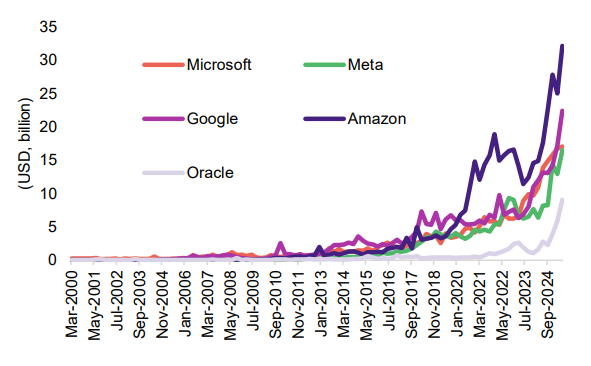
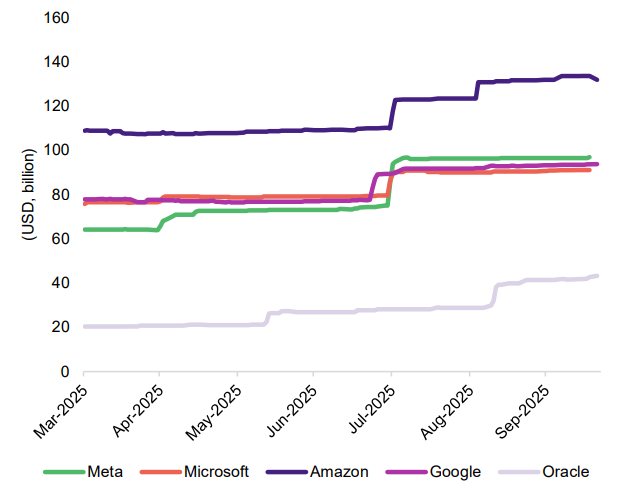
At an Amova Global Equity Forum in late August, we examined the recent surge in capital expenditures by the largest US cloud service providers (“hyperscalers”) between late 2024 and 2025. Our colleagues in the Americas presented evidence that hyperscalers were moving decisively away from their all-too-recent “capital-light” model and entering a race to perfect generative AI. According to analysts’ forecasts, this race is just beginning; capital expenditures are expected to expand from here (see Charts 1 and 2).
Chart 1: Capex by major tech companies have expanded rapidly
Source: FactSet as of 30 June 2025
Chart 2: Analysts’ CY2026 capex forecasts for major tech companies
Source: Bloomberg as of 20 October 2025
As a result, net fixed assets have surged as a proportion of total assets, while fixed asset turnover continues to decrease. By these measures, hyperscalers have now joined “heavyweight” capital accumulators such as US large-cap oil and energy companies.
One notable aspect of the ongoing wave of capital expenditure is the conspicuous absence of rising depreciation costs— whether in current estimates of depreciation and amortization as a proportion of EBITDA, or in analysts’ forward earnings projections. Some large cloud service providers, of course, have decided to lease infrastructure, effectively shifting depreciating assets off their balance sheets. There is also variation in capex across hyperscalers, such as Microsoft’s cloud-focused investments vs. Amazon’s logistics-driven spending. Still, infrastructure spending does not account for the entirety of hyperscalers’ recently scaled-up expenditures. Servers represent a large proportion of capex, and firms may struggle to fully exploit the innovation potential for these investments before they become obsolete.
Several large cloud service providers have recently extended the useful life of servers and networking equipment by around a year. However, this modest extension stands in stark contrast to the long duration of investments implied by their lofty price/earnings ratios (and therefore their terminal values). The useful life of a server is a relatively brief five to six years. Moreover, the obsolescence curve may not be linear, with some forms of technology ageing faster than others. For example, it is broadly accepted that five-year-old GPU’s are no longer useful for what is termed an “existential” (and therefore resource-intensive) investment: training the frontier AI models of hyperscalers in their quest for Artificial General Intelligence (AGI).
In short, the burden on earnings from increased depreciation costs that comes alongside a surge in fixed asset investment is not yet reflected in market earnings estimates, but will likely be over time. If some of the investments lose the battle against time and become increasingly obsolete, future write-downs of unproductive assets may become inevitable.
Hyperscalers may be undergoing a structural shift—from high-multiple enterprises to fixed-capital models with industrial-style risks and depreciation headwinds. A report from Bain Capital
warns that AI’s infrastructure boom involves “insatiable compute demand” that could require up to US dollar (USD) 500 billion annually in new data centres, thereby putting a
strain on funding capacity.
What has changed in the last month? Love of leverage
If AI investments have truly made a structural break, it is also possible that AI finance is entering a late-cycle phase involving increasingly risky capital structures funding shorter-lived assets. Recent examples of leveraged and securitized funding in AI infrastructure to meet surging capital requirements include:
- OpenAI–Oracle’s USD 100 billion vendor financing loop
- Oracle’s USD 18 billion bond issuance
- CoreWeave’s USD 2.6 billion loan and USD 1.75 billion bond package
- Anthropic’s USD 13 billion capital injection from Qatar and others
Some AI-related funding structures, such as vendor financing, are non-recourse or internally collateralized, and not all pose systemic risks. Nonetheless, the trend is pointing towards greater leverage.
Meanwhile, the current capex boom may be contributing to a duration mismatch—short-lived assets funded by long-duration equity valuations—which remains a latent risk alongside the accelerated acquisition of rapidly depreciating assets.
“Involution” (内卷), American style?
The Chinese government is currently pursuing a campaign against excess capacity driven by “involution” (内卷)—described as a form of self-reinforcing competition that yields diminishing returns. While the flood of investment that fuelled China’s “race to the bottom” in price competition differs from the US’s “existential” race toward AGI, both may share a similar characteristic: a self-reinforcing capital expenditure contest. In short, our US colleagues ask a compelling question: is the AI build-out a strategic overcommitment, where capital spending may outpace economic rationality? For equity markets, the key issue is whether hyperscalers, particularly founder-led firms, will pull back if returns on common equity begin to decline. The answer is far from certain.
Cyclically cautious, structurally selective
Hyperscalers continue to dominate the digital platform landscape, yet their current investment surge appears less a rational extension of structural advantage and more a capital-intensive race for survival. The recent boom in US capital expenditure has been shaped by episodic forces—including front-loaded investment ahead of possible tariff hikes, a weaker dollar that made US assets relatively cheap for foreign investors and full-expensing provisions that allow immediate depreciation of capital costs proposed in a recent US fiscal package.
A powerful mix of factors—notably the exponential ramp-up in AI infrastructure spending, intense competition among hyperscalers and accommodative liquidity conditions—has enabled investment to extend far beyond structural requirements. Front-loaded inventory accumulation, energy-supply security measures and opportunistic financing have all amplified non-structural capex in recent quarters.
To disentangle the secular AI investment wave from these cyclical drivers, several distinguishing features are worth noting:
- A rapid escalation of AI infrastructure spending dominated by a few global platforms rather than dispersed adoption.
- Regional spillovers, with AI data centre construction acting as a quasi-fiscal growth driver in areas far from traditional tech hubs.
- Rising marginal capital intensity as compute capacity expands faster than monetizable end-demand.
- A weakening of operating leverage, with revenue growth no longer outpacing surging depreciation and energy costs.
- An early sign that cash returns are being deferred or diluted as excess free cash flow is redirected from buybacks to sustaining capex.
Earlier cycles of experimental, low-return projects—such as metaverse and autonomous-vehicle ventures—offered a preview of misallocated capital. However, what has followed is broader in scope. Since 2023, hyperscalers have pivoted from a phase of capital austerity to an “AI arms race”, reigniting capex expansion at a pace rivalling the dotcom and telecom build-outs. While consolidated CFROI remains elevated, it is trending down as depreciation and financing costs rise.
The scale of current spending carries systemic implications. The goal of “AGI” remains undefined, and the near-term revenue elasticity of AI consumption models—such as co-pilots, inference services and LLM subscriptions—appears modest relative to the capital being deployed. Funding markets are likely to eventually feel the weight of this liquidity absorption, with knock-on effects on valuations and risk premiums.
Moreover, policymakers—who benefit from AI-driven regional growth and risk criticism if they issue untimely warnings in unpredictable markets—are unlikely to intervene . Yet the risk is rising that the present capex cycle could prove low return, margin dilutive or even loss making—a reminder that the search for enduring quality now depends on distinguishing technological progress from reflexive financial momentum.
Structural positives, with variable arrival time
AI has great potential to transform how individuals and businesses interact with and make use of technology. There is no indication that the incredible growth rate of AI revenues will imminently slow. Yet even with these revenues, some of the players could be making investments that will end up with disappointing returns. The structural direction is likely to be positive but potentially uneven.
Our Edinburgh-based Global Equity team believes it is still early days for AI, and that the adoption curve may be more rapid for some technologies and firms than others—especially given the pace of uptake in this cycle compared to previous tech waves. The team expects profitable use cases to emerge, even if some capital is misallocated along the way.
The macro view: picking the structural from the cyclical
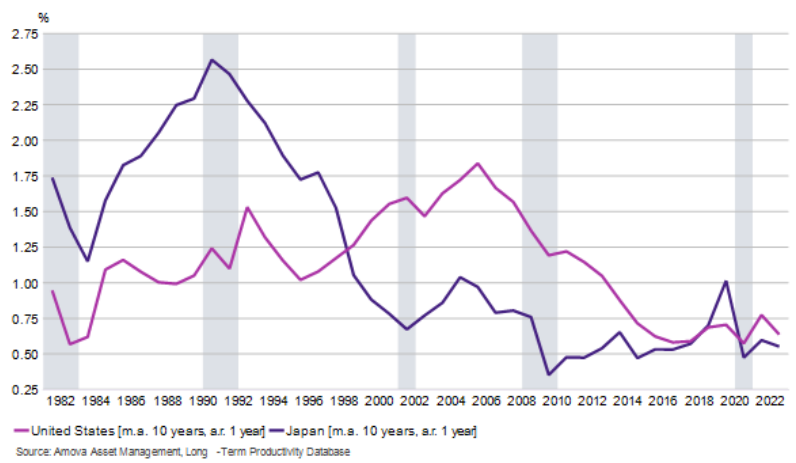
Hyperscaler capex, at its current scale, raises a greater macroeconomic question. In our view, large-scale investments, such as those seen during the most recent US expansion cycle, are likely to contribute to gains in total factor productivity over time. However, these gains do not appear to have materialised yet (see Chart 3), despite the ongoing praise for rising labour productivity (GDP per worker) in US production. These potential future gains still make a long-term investment case for the US worthwhile, in our view.
Chart 3: Total factor productivity, constant prices, USD
(see: Borrowing From the Future Means Reliance on Growth, and Inflation | Chief Investment Officer ).
Investing in structural growth payoffs makes it necessary to weather business cycles along the way, meaning that investors must be prepared to insulate against market risk. It is by no means certain that any coming surge in broader US total factor productivity will predate the next economic downturn . During the late 1990s and early 2000s tech boom, higher total productivity did eventually emerge, but only after the bust. We have outlined before that downturns may increase opportunities for skilled stock-pickers . We describe ways in which understanding economic convergence may offer guidance.
Discerning future value from froth: four signals from economic equilibria
As we look to benefit from future productivity gains, economic models can help separate high-potential growth drivers from assumptions unlikely to survive the next downcycle. To do so, we study how markets may converge towards long-term economic equilibrium. We focus on four specific characteristics of economic equilibria:
- Human skills and machines co-evolve over time
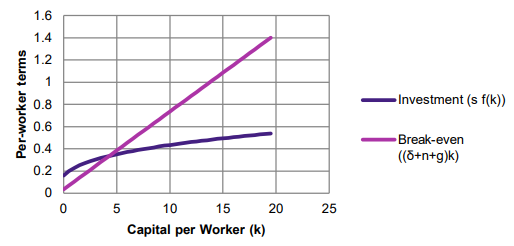
In a capital-only model, tomorrow’s capital equals depreciation of today’s capital plus today’s investment, which rises until a breakeven point. In fact, without human capital, growth halts once investment equals depreciation.
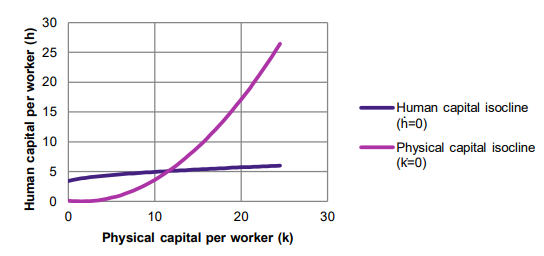
With human capital (education, skills, health), which can also be cultivated through investment in education, training and healthcare as well as R&D spillovers, this equilibrium can be pushed out further (see graphics below). Hence, firms that use technology for the sole purpose of “ making labo u r redundant ” are less likely to outlast competitors who develop both physical and human capital. Simply reallocating from labour to physical capital over time does not expand the economy’s production possibility frontier.
Firms that are engines of sustainable growth innovate to better harness both physical and human capital and allocate efficiently between the two. Meanwhile, shares of income from labour and capital are mean reverting, avoiding the “machines taking over” narrative.
- Price = Marginal cost = Average cost
Aggregate economic profits net to zero when resources are optimally allocated. Therefore, it is advisable to be sceptical of claims that any firm can sustain profits forever without innovation. In the long term, high-profit industries or sectors attract new entrants, who then increase supply, which subsequently puts downward pressure on prices. As competition intensifies, the incumbents lose pricing power. “Alpha” is a moving target, and it moves at the production possibilities frontier.
It is efficient to expect only those firms that expand that frontier to earn above-average profits. It may be beneficial to partially focus on well-researched , smaller-cap firms with potential to grow into tomorrow’s large-cap innovators.
- Constant returns to scale
The economy on aggregate tends to produce roughly in proportion to its inputs (plus the alpha of total factor productivity). While this does not rule out periods of increased production or investment, it should not be interpreted as evidence that the economy, or large sectors of the economy, is capable of producing consistently with increasing returns to scale.
At present, some features of hyperscalers suggest that their larger size currently reduces networking costs per unit of computational capacity; in addition, learning effects may also increase efficiency. Furthermore, hyperscalers are renowned for buying chips, electricity and bandwidth in bulk at prices only accessible to them. Yet there are reasons to be sceptical of the “increasing returns to scale” argument. Engineering constraints like power density, cooling and latency requirements limit how far data centres can be scaled. Adding servers meets additional demand but does not improve efficiency. Assuming that hyperscalers ’ indivisibility is permanent may not be a safe long-term view to hold .
- Fiscal policy is not only a tailwind, but also a risk
While monetary policy is cyclical, US firms and consumers have also been the beneficiaries of significant fiscal stimulus packages, which generally act as tailwinds to economic growth in the country. Yet with GDP per unit debt (the inverse of debt-to-GDP) at historical lows, fiscal expansion is already delivering diminishing returns.
When an economy such as the US issues debt to cover interest costs, concerns over sustainability increase. If tax revenues are increasingly insufficient to cover non-interest expenditure (otherwise known as primary balance), the economy becomes more vulnerable to suffering prolonged impacts from any negative shock.
In such a scenario, if hyperscalers’ large capital investments fail to generate returns quickly enough to offset depreciation costs, there may be little the government can do. It is thus wise to assess whether a firm is overly dependent on decreases in tax or interest costs. If eventual fiscal tightening coincides with corporate margin compression, it could amplify a cyclical downturn.
Example 1: Classic Solow–investment vs. break-even (steady state where curves meet)
Source: compiled with data retrieved from ChatGPT
Example 2: Breakeven in the presence of both machine and human capital
Source: compiled with data retrieved from ChatGPT
Investment implications: structural selection
- Beware of “picks and shovels” when the cycle turns
Our focus remains on insulating long-term, high-conviction themes from cyclical drawdowns. Firms with duration mismatches or highly leveraged financing structures face greater downside risk as capital costs normalise. As current AI compute contracts expire, GPUs and memory may become increasingly commoditized, and scale will cease to offer the same supply advantage. When this occurs, investors financing the capex boom may demand higher risk premiums to refinance or roll over exposure—thereby pressuring valuations for “picks and shovels” suppliers dependent on sustained high hardware demand.
- Human capital investment can separate “expensive” from “future value”
In a high-valuation environment, the critical task is to separate cyclical resilience from structural advantage. Firms that invest in human capital—notably through engineer-led client integration or proprietary solution design—may sustain durable returns beyond the current investment cycle. This is particularly relevant for AI implementation specialists and smaller-cap firms, whose value lies in adaptive problem solving rather than sheer compute intensity. By contrast, companies relying solely on capital-intensive infrastructure risk being stranded if end-demand slows before depreciation runs its course.
- Network effects: cycle-sensitive but return-diversifying
Both listed and unlisted participants are competing in the race toward advanced AI capability. Yet foundation-model innovation is readily replicable, limiting the durability of early technological advantage. Conversely, platform incumbents with diversified revenue streams—especially those with advertising or self-reinforcing ecosystems—may partially offset cyclicality in AI infrastructure returns. These firms are not immune to macro downturns, but their network-driven economics can make valuation-driven entry points attractive during cyclical corrections, especially when they are expected to continue increasing productivity in the long-term.